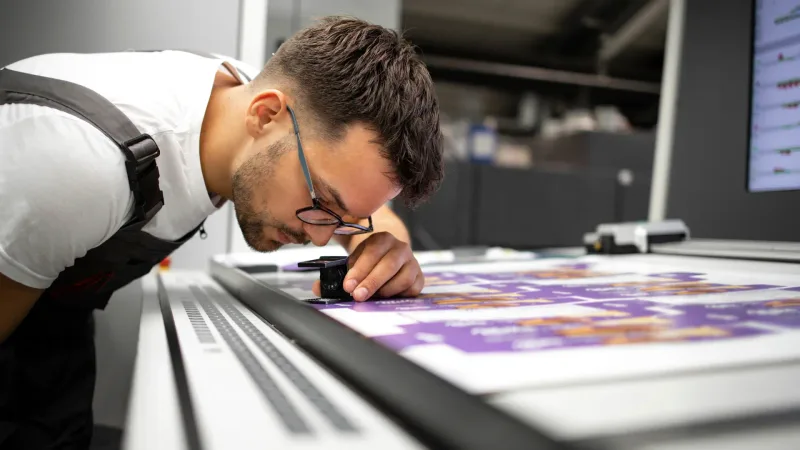
Physical carriers of trust. Which business print materials actually work for a small business?

Think about how many ads you scrolled past on your phone today without your eyes stopping for even a second. Digital messages are fast, cheap and gone just as quickly. When someone hands you a business card, a thank-you note or a carefully packed order, though, things are completely different. A physical object has weight and texture, it stays on the desk and you can’t close it with a flick of your thumb. That’s why well-chosen business print materials still build trust more effectively than many online campaigns, as long as you pick the ones that actually do the work.
Why paper still works
People judge a business by everything they can see and touch. A thin, flimsy card with a blurry logo says someone skimped on the details, and that impression easily carries over to the service itself. A solid card on good paper says the opposite before a single word is spoken.
Print also has one advantage that can’t be faked online: durability. An email with your proposal disappears under the next messages, while a well-designed folder or card stays on a client’s desk for weeks. That’s not sentiment, it’s pragmatism. Material that stays in sight reminds people of you at no extra cost.
Business print materials that actually work
You don’t need the full set right away. For a small business a few items matter, chosen to match how you meet your customers:
- Business cards: still the foundation for in-person meetings. In Poland the standard size is 90 × 50 mm, and paper around 350 g/m² gives a pleasant stiffness.
- A proposal template and letterhead: even if you mostly send them as PDFs, a consistent layout with your logo and colors makes a big difference when a client compares several offers.
- Stickers and labels: the cheapest way to make a plain box or bag look like yours. They work well for online shops and makers.
- A thank-you card: tucked into an order it costs pennies, and it’s often the very thing customers photograph and post online.
- A flyer or offer card: only if you have someone to hand it to, for example at a service point or a trade fair. An A5 or DL (99 × 210 mm) format fits one clear idea and a call to action.
Folders, calendars and branded giveaways only make sense once you regularly hand clients documents or build relationships over years. At the start you can usually skip them.
Where not to cut corners, and where you can
The two places where saving money backfires are the paper for your business cards and the quality of file preparation. The price difference between a thin card and a solid one is small, while the difference in how it’s received is huge. Mistakes in the file, on the other hand, cost you the whole run.
Where you can save is on run sizes. Digital printing makes even small batches reasonable, so instead of a thousand business cards that go out of date with your first phone number change, order two hundred. The same goes for finishes: soft-touch lamination, spot UV or embossing are impressive, but one well-chosen finish is enough. Several at once start competing with each other. Mass flyers stuffed into mailboxes, meanwhile, are a questionable investment, since most of them end up in the trash before anyone reads them.
The paper itself is a separate decision. Coated paper gives vivid colors and a smooth surface, while uncoated paper feels more natural and takes pen ink better, which matters for things like thank-you cards. A matte finish looks calmer and doesn’t reflect light, while gloss makes photos pop. If you’re not sure, ask the print shop for a paper sample book and hold it in your hands, because a photo online won’t show the difference in thickness and texture.
Print doesn’t forgive file mistakes
A screen forgives a lot, since you can fix a web page in a minute. In print, one mistake means a new run. That’s why every file sent to a print shop should have its colors prepared in CMYK, which I cover in detail in my article CMYK or RGB for print. Then there’s bleed, usually 2–3 mm of background extending past the trim line to prevent white slivers at the edges, and a safety margin so no text gets cut off.
Photos should be about 300 dpi at their final size, and fonts must be embedded in the PDF or converted to outlines. It sounds technical, but details like these are exactly why business cards come back from the print shop with the phone number cut off.
Your silent salesperson
Your business print materials work when you’re not around. A business card left after a meeting or a card included in a package represents you in conversations you’re not part of. That’s why it has to look the same as your website and social media profiles, because a customer who scans the QR code on a flyer should land somewhere familiar, not in a completely different style. I write about how to keep that kind of consistency in my article on visual identity and brand guidelines.
One practical tip to finish: if you add a QR code, test it with a phone on a printed proof, not just on screen, and point it to a specific page, such as your contact page or portfolio, rather than just your homepage.
Time to get specific
If you’re tired of materials that look cheap and spoil the impression every time you meet a client, write to me. A simple business card design starts at around 500 PLN with me, and you’ll find full prices for print design on my services page. I’ll design materials that match the rest of your brand and prepare files you can send straight to the print shop of your choice, with no corrections and no surprises at pickup.